
How much power a blower usually needs
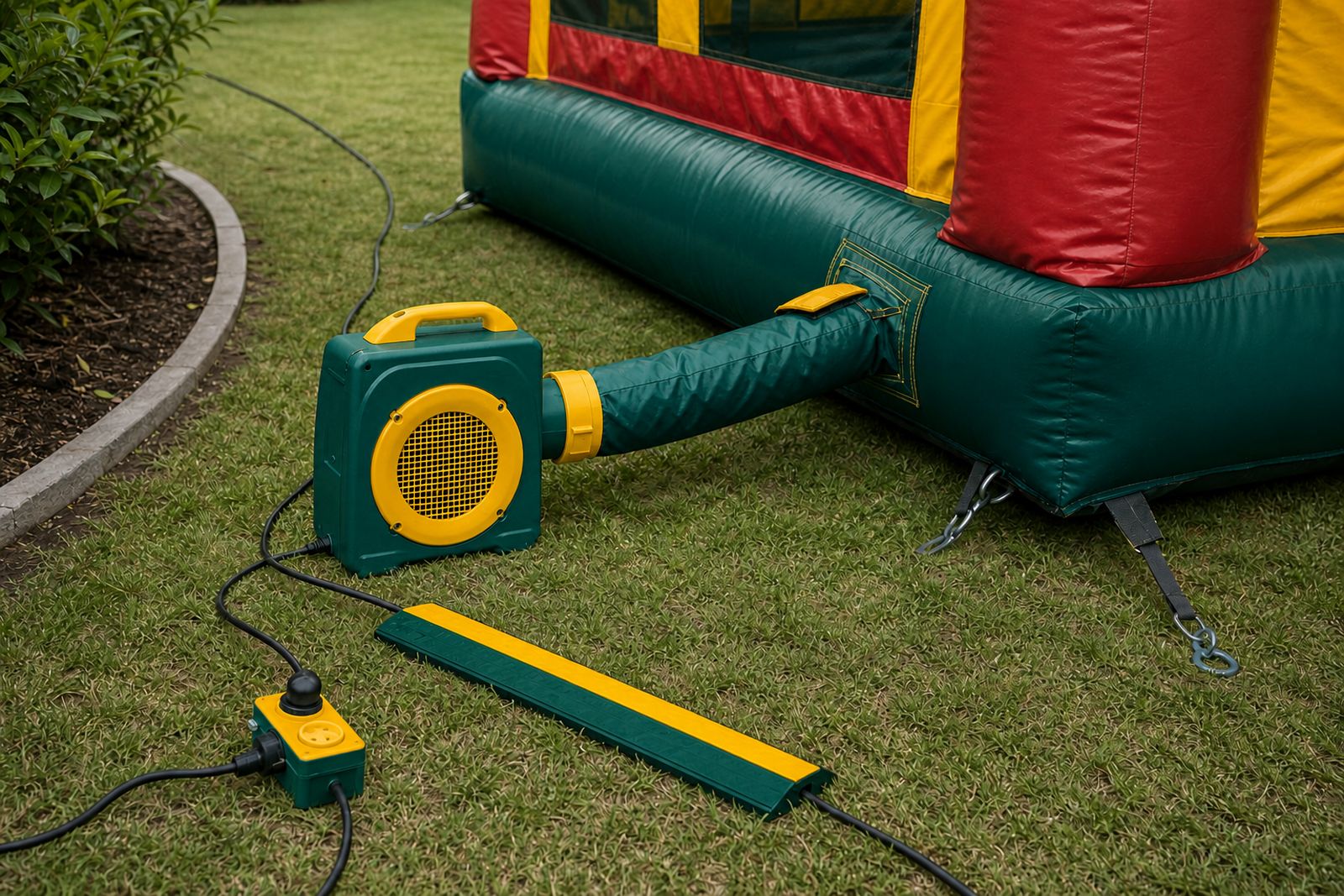
Socket planning should begin with the venue map, not the truck unload. A clean cable route avoids trip points, keeps sockets away from water and prevents the crew from stretching leads across gates, tables or service corridors.
For indoor halls in Johannesburg or Pretoria, the main issue is usually distance. A hall might have sockets along one wall only, which means the cable may need to run around the edge of the room instead of through the middle. Outdoors in Durban, damp grass and sudden showers add another layer, so the crew keeps connections off wet ground and uses covered joins where needed.
- Measure the route from socket to blower, not just the straight line.
- Keep leads out of public walkways and queue areas.
- Use cable covers where the route crosses a path.
Anchoring, mats and the ground under the unit
Power is only part of the story. A blower can do its job and still leave a poor result if the inflatable is not anchored properly or if the ground is uneven. Pegs, sandbags or other approved weights are matched to the surface, and safety mats go where children climb in and out, especially on hard paving or patched school fields.
Midrand sites often mix grass, paving and parking areas in one event space. That means the setup crew has to read the ground, not just the booking note. If the surface is loose after rain, extra anchoring may be needed. If the event sits on a roof deck or tiled courtyard, the crew plans around surface protection and movement control.
- Anchor points should suit grass, paving or indoor flooring.
- Mats help at entries, exits and around busy corners.
- Wet or sloped ground needs a stricter layout check.
When a generator makes more sense
Some venues have enough supply on paper but not in practice. Long cable runs, shared circuits and other equipment can push the setup beyond what is comfortable for a busy event. In those cases, a generator can be the cleaner option, especially for outdoor family days, roadshows and township festivals where the play zone sits far from the nearest socket.
The crew still has to match the generator to the load, allow fuel planning and keep noise in mind near speakers or announcements. A photo booth, popcorn cart and inflatable may each need their own planning line, and the total load matters more than any single machine. In Cape Town winds, the team also watches where the generator sits so exhaust, dust and loose cables do not create a second problem.
- Generator size must suit the full event load.
- Fuel, placement and cable routing need a clear plan.
- Keep the machine away from guests and service queues.
What trained crews check before the first child climbs in
Once the blower starts, there is still more to do. The crew checks airflow, zip doors, entry points, anchor tension and the way children move through the unit. For taller inflatable slides and obstacle runs, age and height guidance matters as much as the power plan, because crowding at the entrance can put pressure on the structure and the attendants.
At mall activations and school fun days, a trained team may also manage queue flow, rest breaks and wet weather adjustments. If the forecast shifts, the setup can be paused, covered or packed down in a sensible order. That is part of the same service as delivery and collection, because an inflatable event only works when the full run is managed with care.
- Check blower pressure before opening the unit to guests.
- Watch entrance flow, age grouping and height limits.
- Use attendants where the event has heavy foot traffic.
A Midrand example with a long cable run
Picture a school sports day in Midrand with a jumping castle on one side of the field and a shaded spectator area on the other. The nearest socket is inside a hall, so the cable route has to cross a paved path, turn around a fence line and stay clear of children moving between stalls. The crew measures the route, places covers where the lead crosses a walkway and positions the blower where it will not collect dust or water.
Now add a popcorn cart and a small foam machine. The power plan gets tighter, so the team may split loads across different circuits or switch to a generator. The detail is not glamorous, but it keeps the event steady from setup to strike. That is the sort of planning that matters for birthdays in Sandton, mall days in Centurion and larger road shows heading to Durban or Bloemfontein.
- Longer cable routes need more care than most guests notice.
- Multiple amusements should never share a vague power plan.
- Setup time grows when access, weather or ground conditions change.